7 Weird But Genius Long Flight Hacks You Will Regret Not Knowing
Mastering the Long Haul: 7 Uncommon Yet Effective Hacks for Long-Distance Flights
After spending over a decade navigating the globe—from the humid corridors of Southeast Asia to the freezing altitudes of transatlantic flights—I have learned that survival on a long-haul flight isn’t about luxury; it is about strategy. Most travelers rely on the basics: a neck pillow, some headphones, and a prayer for a sleeping neighbor. However, the difference between arriving feeling like a zombie and arriving ready to explore lies in the details.
The environment of a pressurized cabin is hostile to the human body. Low humidity, recycled air, and static positioning create a trifecta of physical stress. To combat this, you need a toolkit of unconventional strategies that address the physiological and psychological tolls of long-distance travel.
1. The Saline Nasal Spray Secret
Most people focus on hydrating their skin or drinking water, but they forget the most vulnerable entry point: the nasal passages. Airplane cabin humidity often drops below 20%, which is drier than the Sahara Desert. This leads to “airplane congestion,” headaches, and a significantly increased susceptibility to airborne viruses because your mucus membranes dry out and stop filtering pathogens.
The Hack: Use a simple, non-medicated saline nasal spray every three to four hours. By keeping your nasal passages moist, you maintain your body’s first line of defense against illness and prevent that uncomfortable, stinging sensation in your sinuses. It is a small addition to your carry-on that drastically changes how you feel upon landing.
2. The “Do Not Disturb” Visual Shield
Social anxiety is a hidden stressor on long flights. Whether it is a chatty seatmate or a flight attendant waking you up for a meal you don’t want, constant interruptions prevent the deep REM sleep necessary to fight jet lag.
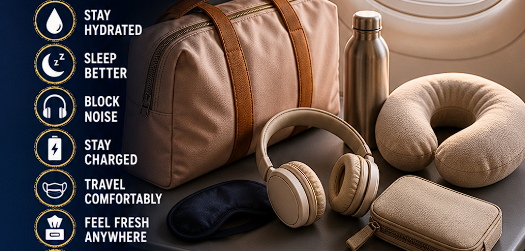
The Hack: Combine a high-quality, contoured 3D eye mask with over-ear noise-canceling headphones. The key here isn’t just the comfort; it is the signal. In the psychology of travel, this combination serves as a universal “Do Not Disturb” sign. When you are visually and auditorily sealed off, people are significantly less likely to disturb you, allowing you to enter a deeper state of rest that is nearly impossible to achieve in an open cabin.
3. Strategic Hydration Timing
Standard advice is to “drink plenty of water.” However, drinking massive amounts of water throughout the flight often leads to frequent trips to the cramped airplane lavatory, disrupting your sleep and increasing the risk of DVT (Deep Vein Thrombosis) by making you move in erratic intervals.
The Hack: Front-load your hydration. Drink 32 ounces of water two hours before boarding and continue sipping steadily until takeoff. Once in the air, shift to a “maintenance mode”—sipping water specifically to counteract the sodium in airplane meals. Avoid the “chugging” habit mid-flight; instead, focus on electrolytes. A magnesium or potassium supplement before the flight can also help prevent the muscle cramping and bloating associated with cabin pressure.
4. The Lumbar Support Bridge
Economy seats are designed for the “average” human, which means they rarely fit anyone perfectly. After six hours, the gap between your lower back and the seat leads to lumbar strain and that nagging ache in your hips.
The Hack: Use a rolled-up piece of clothing—a sweater or a pashmina—and place it precisely in the curve of your lower back. To take it a step further, if you have a soft-sided carry-on bag under the seat in front of you, position it so your feet are slightly elevated. This shifts the angle of your pelvis, reducing the pressure on your spine and preventing the “slump” that leads to lower back pain.
5. The Pulse Point Reset
Mid-flight fatigue often manifests as “brain fog” or a feeling of claustrophobia. This is usually caused by a combination of dehydration and a stagnant nervous system.
The Hack: Request a cold damp towel from the flight crew or use a chilled wet wipe from your own kit. Apply it to your pulse points: your wrists, the back of your neck, and your temples. The sudden drop in temperature triggers a mild “diving reflex,” which can lower your heart rate, wake up your senses, and snap you out of a mental slump without the need for more caffeine, which would only further dehydrate you.
6. The Temperature Layering System
The “airplane chill” is real. Cabin temperatures fluctuate wildly between the takeoff climb and the cruising altitude. Many travelers make the mistake of wearing one heavy layer, which leads to overheating when moving and freezing when still.
The Hack: Adopt a three-tier system. Base layer (breathable cotton/merino), mid-layer (light fleece), and an outer shell. The “genius” part? Bring a dedicated pair of thick wool socks used *only* for the flight. Your feet are the first to lose heat; once your core temperature drops because of cold feet, you will struggle to sleep. Slip them on the moment you hit cruising altitude and remove them 30 minutes before landing to stimulate blood flow.
7. The “Fake-Out” Meal Strategy
Airline food is notoriously high in sodium to compensate for the fact that your taste buds are dulled at high altitudes. This sodium causes your body to retain water, leading to swollen ankles and a feeling of lethargy.
The Hack: If you can, skip the heavy main course and rely on high-protein, low-sodium snacks you’ve brought yourself (like raw almonds, apple slices, or protein bars). If you do eat the plane meal, eat the protein and vegetables first and leave the processed breads and salty sides. By reducing the sodium spike, you avoid the “bloat” and the subsequent energy crash that usually hits three hours into the flight.
How These Insights Were Developed
The strategies outlined in this guide are not based on generic travel lists. They are the result of a decade of international travel, encompassing over 500 flights across every continent. These hacks have been refined through iterative testing—trying various combinations of hydration, gear, and biological resets—to determine what actually works in the high-pressure environment of a commercial aircraft. The goal is to transition from merely “enduring” a flight to actively managing your physiology for peak performance upon arrival.