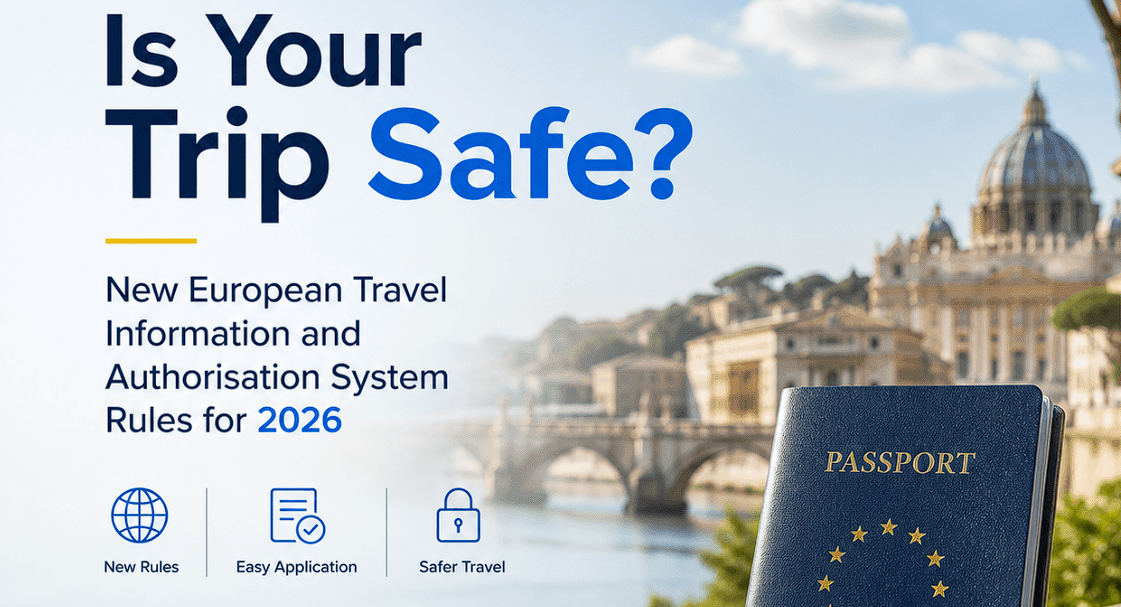
Is Your Trip Safe? New European Travel Information and Authorisation System Rules for 2026
New European Travel Information and Authorisation System
If you have a Europe trip sitting in your calendar for 2026, there is one thing you should not “figure out later”.
Not because it is scary. Not because it is complicated. But because it is exactly the kind of small administrative thing that can turn into a big headache at the airport. The kind where you are standing there with your passport in your hand, boarding time creeping closer, and someone behind a desk says, sorry, you do not have the right authorisation.
What I am talking about is the European Travel Information and Authorisation System. ETIAS.
In normal human terms, it is a pre travel permission for visa free travellers. It is not a visa. It is not a stamp. It is more like, you fill out a form online, pay a small fee, and get a yes in the system before you arrive.
And the big point for this article.
In 2026, ETIAS rules are expected to matter in real life for a lot of travellers, because Europe is rolling out its new border setup in phases. There is ETIAS, and there is also the Entry Exit System, EES, which is the new fingerprint and facial scan system replacing the old manual stamp routine for many people. They are linked in the sense that they are part of the same bigger plan, and they affect the same group of travellers.
So yeah. If you are asking, is my trip safe. That is the headline feeling.
The answer is basically: your trip is safe if you plan for the new rules. If you ignore them, you might be fine. Or you might not. And the not fine scenario is avoidable.
Let’s break it down calmly. With details. With the stuff people actually ask. And with the slightly annoying edge cases that catch real families and real travellers every year.
What ETIAS is, and what it is not
ETIAS stands for European Travel Information and Authorisation System.
It is a travel authorisation program for people who can currently travel to the Schengen Area without a visa for short stays. Think 90 days in any 180 day period.
So when someone says, “Do I need a visa for France as an American” and the answer is “No, you can enter visa free.” That person is the ETIAS target audience.
Important: ETIAS is not a visa.
A visa usually involves a bigger application, more documents, and a consulate or embassy process. ETIAS is more like an online screening step. You apply online, you get approved, you travel. Similar concept to the US ESTA, or Canada’s eTA, if you have seen those.
ETIAS also is not the same thing as EES.
EES is the biometric border system that records entries and exits digitally. ETIAS is the pre travel permission. Two different tools, same overall direction.
The reason people mix them up is because they show up in the same conversations, and because they both affect “you with the regular passport who normally just shows up and gets stamped.”
What is changing in 2026, exactly
The big “2026” anxiety is really about timing and enforcement.
Europe has been working toward a modernised border system for a while. The old way is:
- You arrive.
- An officer looks at your passport.
- They stamp it.
- You go.
The new way is going to be more digital and more automated, with biometric registration at the border for many travellers, plus a requirement for certain visa free travellers to have ETIAS approval before departure.
By 2026, ETIAS is expected to be a standard part of travel for eligible travellers. So airlines and border checks can treat it like a basic requirement. Like, you cannot board without it, in the same way many airlines already check for other permissions depending on destination.
One more thing. Because it matters.
Rollouts are often phased. Some travellers get caught in transition periods where rules exist, but people are still learning them, and enforcement is uneven. That sounds like it might make things easier. Sometimes it does. Sometimes it makes it worse, because you end up with different instructions depending on which airline agent you get, or which airport, or which country you fly through.
So the practical “2026 rule” mindset is:
If you are visa free to Schengen and ETIAS is in effect for your nationality at the time of your trip, you should assume you need ETIAS.
Not “maybe”. Not “I will do it at the airport.” Do it in advance.
Who needs ETIAS
ETIAS is designed for nationals of countries that have visa free access to the Schengen Area for short stays.
That includes travellers from places like:
- United States
- Canada
- United Kingdom
- Australia
- New Zealand
- Japan
- South Korea
- Singapore
- Many countries in Latin America, and more
I am not going to dump a full country list here because it is long and it can change over time. The right move is always to check based on your passport nationality. Not where you live. Not your second passport unless you are travelling on it. The passport you will use to enter the Schengen Area is the one that matters.
Also, if you already need a Schengen visa, ETIAS is not for you. That is a different process.
And if you are an EU citizen, or a citizen of a Schengen country, you do not need ETIAS.
There are also exemptions for certain residents and certain categories of travellers. For example, if you have a residence permit in a Schengen country, you usually follow a different rule set. But do not guess. This is where people get burned. They assume their residence card covers everything, then they travel on a passport that triggers other requirements, and it gets messy.
If you are in that category, dual nationality, long term resident, family member of an EU citizen, anything like that, it is worth checking carefully.
What countries are “Schengen” and what countries are “Europe but not Schengen”
This is another place where people mess up.
ETIAS is for the Schengen Area. Not “Europe” as a continent. Not “the EU” as a political bloc. It is specifically Schengen.
Schengen includes many of the countries most travellers think of first, like France, Spain, Italy, Germany, Netherlands, Greece, and so on.
But there are European countries that are not in Schengen. And there are non EU countries that are in Schengen. So you cannot do the lazy shortcut of “If it is EU, it is Schengen” or “If it is Europe, it is Schengen.”
And the reason you care is because Schengen rules control:
- The 90 in 180 short stay clock
- The border checks you face
- Whether ETIAS applies
If your itinerary includes both Schengen and non Schengen European countries, your entry and exit points matter.
A simple example.
You fly into Paris, travel around Schengen, then go to the UK, then come back to Spain. That is a re entry into Schengen. If ETIAS is required, you need it for the Schengen entries. Not for the UK part. But the UK portion does not “reset” your Schengen clock in the way some people casually assume. It is a separate thing.
Another example.
You fly into Dublin. Ireland is in the EU but not in Schengen. So Schengen rules are not automatically triggered by entering Ireland. But if you then fly to Germany, now you are entering Schengen.
So, when you plan for ETIAS, plan for the Schengen legs, not the “Europe vibes.”
How ETIAS works, in practical terms
For most travellers, this is what ETIAS looks like.
- You apply online before travel.
- You provide personal details, passport details, travel details, and answer a set of background questions.
- You pay a fee if you are in the paid category.
- The system checks your information against security and migration databases.
- You get a decision.
Many applications are expected to be approved quickly, sometimes within minutes. But “expected” is not the same as “guaranteed.”
Some applications may require manual review. Some may require additional information. Some may be refused.
So the correct travel behaviour is:
Do not apply the night before you fly. Not even if the website says it is usually fast.
Apply early enough that if you hit a delay, your trip is not in danger.
I know. It feels annoying. It is one more thing. But it is the price of the new setup.
How long is ETIAS valid
ETIAS authorisation is intended to be valid for multiple trips over a period of years, tied to your passport validity. If your passport expires earlier, the authorisation ends when your passport ends.
So in many cases, you do it once and you are done for a while.
But.
If you renew your passport, you will likely need a new ETIAS, because the authorisation is linked to the passport number and document details. People forget this. They get a new passport, they keep the old approvals in their head, and then they show up with a new document. The system does not care about your head.
So if you renew your passport in 2025 or 2026, build that into your checklist.
In addition to ETIAS, some countries like Canada require an ETA for entry which also needs to be applied for ahead of time and follows similar guidelines.
Can you use ETIAS for multiple countries
Yes. ETIAS is not for a single country. It covers the Schengen Area. You still have to follow entry rules, like purpose of travel and length of stay, but you do not get a separate authorisation for France and another for Italy.
Is ETIAS required for children
This is a big family travel question.
ETIAS generally applies to travellers, including minors, if their nationality is one that requires ETIAS. The fee may differ by age group, but the authorisation itself is still a thing.
So if you are travelling as a family, do not think of ETIAS as “my thing.” It is an everyone thing.
And that also means you need a passport for the child. A proper travel document. Not a birth certificate. Not a “they are on my passport” setup. Those old arrangements do not work in most modern contexts anyway.
Do you need to print ETIAS
ETIAS is electronic. It is tied to your passport. In theory, you do not need to print it.
In real life, I still like having a screenshot or the confirmation email saved offline, just in case you need to show a reference number. Not because it is required every time. Because sometimes systems are slow, airline agents are rushed, and you want to make their job easy.
Also, you may be asked questions during check in. Having the record ready can reduce friction.
The Entry Exit System, and why it is part of your “is my trip safe” question
EES is the new digital system that records when you enter and exit the Schengen Area. It uses biometric data for many non EU travellers, like fingerprints and facial images.
The old system was stamps and manual checking. EES is meant to reduce overstays, improve security, and speed up some processing once you are enrolled. But yes, the first time you use it, it can be slower because you are registering biometrics.
So when people say, “Are borders going to be chaos in 2026,” a lot of what they are worried about is EES. Especially in high traffic airports and train stations, and especially during peak holiday times.
The realistic expectation is:
- The first months of any rollout can be bumpy.
- Some border points will adapt faster than others.
- If you travel at peak times, you should allow extra time for border checks.
This does not mean do not go. It means do not schedule a 45 minute connection that requires clearing passport control when everything is new. Be a little conservative.
Also, if you are doing cross border train travel that involves entering or leaving Schengen, like Eurostar routes, you may see new procedures. That can affect how early you need to arrive at the station.
The “trip safety” part people really mean
A lot of travellers use the word safe when they mean one of these:
- Will I be allowed to board my flight
- Will I be allowed to enter
- Will I get stuck in a long line and miss my connection
- Will I accidentally overstay and get banned
- Will some minor paperwork thing ruin the trip
ETIAS and EES are mostly about those.
They are not about street crime. They are not about whether Paris is safe at night. Different topic.
So if we are sticking to the travel admin version of safe, here is what matters.
1. Airline checks will get stricter
Airlines are on the hook to make sure you meet entry requirements. If they fly you to a destination where you are not eligible to enter, they can face penalties and they may have to fly you back.
So airlines tend to be conservative. They will check.
That means ETIAS is not just a border thing. It is a boarding thing.
If ETIAS is required for your passport, expect airlines to ask or to verify electronically during check in. Possibly even before you reach the gate.
2. Passport validity rules are still a big deal
Even before ETIAS, Schengen has passport validity rules for short stays. Many travellers assume “valid for the whole trip” is enough.
Often it is not.
There are rules around having a certain amount of validity left on your passport when you enter. And sometimes rules around the age of the passport issue date. It depends, and it is worth checking. Because ETIAS approval does not override passport validity requirements. If your passport is not valid enough, you can be denied boarding or entry even with ETIAS.
So if your passport expires in 2026 and you are travelling in 2026, do not be casual about it.
3. The 90 in 180 rule is still there, and EES will track it better
The 90 days in any 180 day period rule for Schengen short stays is not new. What is new is that tracking will become more precise with EES.
The stamp system was imperfect. Sometimes stamps are illegible. Sometimes entry stamps are missing. People argue with border officers about how long they were in.
With EES, the digital record should make overstays harder to “accidentally” do and harder to dispute.
So if you are the kind of traveller who does long Europe trips, or you do multiple visits per year, you need to actually track your days. Not vibe track them.
And if you are close to the limit, do not push it. Overstaying can lead to fines, removal, or entry bans. Not always, but it is possible. And the system is literally being built to detect it more reliably.
4. Refusals and delays are rare, but they happen
Most people will get ETIAS approval smoothly. But some travellers will not.
Reasons can include:
- Passport details entered incorrectly
- Mismatch between name spelling and passport machine readable zone
- Previous immigration issues
- Criminal record flags, depending on the circumstances and rules
- Security concerns
- Data errors that require manual review
Even if you are a perfectly normal tourist with no record and no drama, a typo can cause a problem. If your passport number is wrong, or your date of birth is entered wrong, or you used a nickname, it can create friction.
So the practical advice is simple and boring.
Take your time when you apply. Copy exactly what is in the passport. Double check everything.
How to apply for ETIAS without messing it up
This is the part where most articles get too generic. So I am going to be specific.
When ETIAS is live for your nationality, you apply through the official channels. There will also be scam sites, paid “assistance” sites, and confusing ads. This happens with every travel authorisation system on earth.
So your first rule is:
Do not Google “ETIAS apply” and click the first ad without reading.
You want the official site. And you want to avoid overpaying some random service to type your name into a form.
Second rule.
Have these things ready before you start:
- Your passport, physical, in your hand
- Your travel plan basics, like first entry country, address for first stay if requested
- Your email address, one you can access
- A payment method if required
- A calm 10 minutes where you are not distracted
Third rule.
Use your passport name exactly as it appears. Middle names, accents, spacing, all of it. Some systems are picky. If your passport has diacritics, the system may instruct you how to enter them. Follow the instructions.
Fourth rule.
If you are applying for a family, consider doing it one by one carefully. Do not rush. The most common mistakes I see in these systems are parents mixing up digits in kids passport numbers. It is always a digit. Always.
Fifth rule.
Apply early. In a perfect world, you get approval in minutes. But if you are not in a perfect world, you want time.
If your trip is in June 2026, do not apply in June 2026 unless the rules specifically say you must wait. Apply as soon as you are allowed to apply.
How early should you apply in 2026
There is no single answer because it depends on what the official guidance is at the time and how the system is functioning.
But from a traveller safety perspective, meaning, reducing risk of travel disruption, here is a reasonable approach:
- If your trip is months away and applications are open, apply months away.
- If your trip is weeks away, apply weeks away.
- If your trip is days away, yes apply immediately, but understand you are gambling a bit.
People sometimes worry, what if my plans change. What if I change hotels. What if I change my entry point.
ETIAS is not meant to lock you into a specific itinerary. It is a permission to travel. Plans can change. But again, we will all need to follow whatever the final rules say. Some fields may be optional, some may not. Some changes may be fine, some may need updating.
The safe move is to treat ETIAS like you treat your passport. It is a travel prerequisite, not a booking.
What happens if you arrive without ETIAS
If ETIAS is required and you do not have it, the most likely point of failure is not the border desk. It is before you get on the plane.
Because airlines do checks.
So the likely scenario is:
- You show up to check in.
- The airline system flags missing authorisation.
- You are denied boarding until it is resolved.
Can you apply on the spot? Maybe. If the system is accessible and fast. But you are now doing it under pressure, with airport wifi, with a line behind you. Not ideal.
And if the application needs manual review. You are stuck.
So yes. Your trip safety here is basically: do not put yourself in that situation.
What ETIAS does not guarantee
This is important, because people misunderstand it.
ETIAS approval does not guarantee entry.
Border officers still decide if you meet entry conditions. They can still ask:
- Why are you here
- How long are you staying
- Where are you staying
- Do you have enough funds
- Do you have return or onward travel plans
- Do you have travel insurance, if required for your situation
- Do you have a reason that matches visitor status
Most tourists will never be grilled like this. But it happens. And ETIAS is not a magic shield.
So if you are travelling in a way that looks like you might be working illegally, or you cannot explain your plan, or you have no proof of funds and no return, you can still be refused.
Also, if you have a complicated immigration history, like previous overstays, previous refusals, or something like that, ETIAS can be part of your problem, not your solution.
Common 2026 travel scenarios, and what to do
Let’s do the real life stuff.
Scenario 1: You are flying to Paris for 10 days in July 2026
You are probably a classic ETIAS traveller if you are from a visa free country.
What to do:
- Check if ETIAS is required for your passport at that time.
- Apply early.
- Make sure your passport validity is good.
- Expect EES biometric registration at the border if applicable. Add buffer time on arrival if you have a tight connection.
Scenario 2: You are doing a multi country trip, landing in Spain, leaving from Italy
This is common.
What to do:
- ETIAS covers the whole Schengen area, so you do not need separate authorisations.
- Your 90 day clock covers all Schengen time across the trip.
- Keep an eye on length of stay. Especially if you are also visiting non Schengen countries in between.
Scenario 3: You are doing London, then Paris, then Amsterdam
UK is not Schengen. France and Netherlands are.
What to do:
- ETIAS is relevant for entering Schengen.
- UK entry rules are separate.
- Your Schengen 90 days count only the Schengen days. UK days do not count toward Schengen, but they also do not reset it.
Scenario 4: You are transiting through a Schengen airport
Transit rules can get confusing. Whether you are “entering” Schengen depends on your route.
If you land in Frankfurt and then fly to Rome, you are entering Schengen in Frankfurt because that is where passport control usually happens for that itinerary.
If you land in Madrid from outside Schengen and then connect onward within Schengen, Madrid is your entry point.
What to do:
- Treat your first Schengen airport as the border you need to be ready for.
- If ETIAS is required for entry, you need it even if your “final destination” is another country.
Scenario 5: You are a digital nomad type, doing long stays and hopping around
This is where people get burned by 90 in 180.
What to do:
- Track days properly.
- Consider a long stay visa or residence permit if you plan to spend more than 90 days in Schengen. ETIAS does not make long stays legal.
- Be aware EES will track entries and exits more precisely, so the old “I think I was fine” approach becomes risky.
Scenario 6: You have a criminal record
This one is sensitive and it is very individual.
ETIAS involves background questions and database checks. Depending on the nature of the offence, the time since, and the rules, you might still be approved or you might be refused or asked for more information.
What to do:
- Do not lie on the application. Lying is often worse than the record itself.
- Apply early so you have time to deal with delays.
- If refused, follow the official appeal or review process if available, or consult a qualified immigration lawyer if needed.
Scenario 7: You are travelling with a passport that is about to expire
Do not do the “it expires two months after the trip, it is fine” thing until you verify the exact rule for your case.
What to do:
- Renew early if you can.
- Remember that if you renew, you likely need a new ETIAS because the passport details change.
How to avoid scams and fake ETIAS sites
Whenever a new travel requirement launches, scam sites show up immediately.
They do one of these:
- Charge you a huge fee to “help” you apply
- Collect your personal data
- Provide a fake confirmation
- Offer “expedited approval” that does not exist
So.
Some simple red flags:
- The site looks like a generic agency page, not an official government or EU page.
- The pricing is way higher than what you expect.
- They pressure you with countdown timers.
- They show up as sponsored ads and the URL looks weird.
- They ask for information that makes no sense, like full bank logins or unrelated documents.
The safest approach is:
- Use official sources to find the application portal.
- Do not rely on random blogs for the link.
- If you are unsure, cross check with your government travel advisory site or the official EU channels.
Also, if you are applying at work, or for a group, do not send passport scans through random email chains. Just do it directly with the traveller present if possible.
What you should do right now, even if your trip is far away
Here is the boring checklist that actually prevents problems.
1. Check your passport expiration date
If your passport expires in 2026 or early 2027, you should at least think about renewal now. Processing delays happen. Backlogs happen.
And remember. New passport, new ETIAS likely.
2. Understand your fly rights
Familiarizing yourself with your fly rights can help ensure a smoother travel experience. Knowing what to expect and what you’re entitled to can save you from potential issues during your journey.
2. Know your nationality based requirements
If you have dual citizenship, decide which passport you are travelling on. Then plan requirements based on that passport.
People sometimes travel on one passport for convenience, then realise it triggers different rules. For example, one passport is EU, one is not. That changes everything.
3. Track your Schengen days if you travel often
If you are already a frequent Europe traveller, start tracking your days now. It makes 2026 easier because you already have the habit.
4. Give yourself more buffer time for connections
If you are booking flights for 2026 and you have a choice, do not choose the tightest legal connection through a big Schengen hub if you are arriving from outside Schengen. Especially early in the transition period.
You want a bit of breathing room. It is not fun sprinting through an airport even in normal times.
5. Keep an eye on official updates
This is the annoying part. Dates and operational details can shift.
So you want to check official guidance closer to your travel date. Put a reminder in your calendar for, say, 90 days before departure.
Not daily doom scrolling. Just a planned check in.
Quick ETIAS questions people ask, answered
“Is ETIAS a visa”
No. It is a travel authorisation for visa free travellers.
“Will ETIAS be required for a layover”
If your layover involves entering Schengen, yes. If you remain in international transit without entry, it depends on routing and airport setup. Many itineraries require you to clear passport control at the first Schengen point even if you are connecting onward, so treat it seriously.
“Can I be denied entry even with ETIAS”
Yes. ETIAS is a pre travel screening, not a guarantee.
“How much does it cost”
There is typically a small fee for adult applicants, with potential exemptions for certain ages. Always check official pricing when you apply, because scam sites will inflate it.
“What if I make a mistake on my application”
If you realise immediately, you may need to reapply. Some systems allow updates, some do not. The safest thing is to be careful before submitting.
“Do I need ETIAS if I have a Schengen visa”
No. If you have a visa, you follow the visa process.
“Do I need ETIAS if I live in Europe”
Depends. If you are a resident of a Schengen country with the right residence document, you may be exempt. But do not assume. Check based on your residence status and travel document.
So. Is your 2026 trip safe
Yes, if you treat ETIAS like a real requirement and not a rumour.
The new rules are not designed to stop tourists from visiting. They are designed to make borders more controlled, more digital, more trackable. Which is kind of the whole point.
But the traveller experience changes. There is more admin upfront. There may be more time at the border while EES beds in. And the consequences of forgetting a requirement are more immediate because systems are connected and airlines do checks.
If you want a simple plan.
- Make sure your passport is solid. Expiration, condition, matching name, all of it.
- If ETIAS is required for your passport, apply early and carefully.
- Track your Schengen days if you travel frequently or stay long.
- Add buffer time for borders and connections, especially in early rollout periods.
- Use official sources, avoid scams.
That is it.
And honestly, if you do those five things, your 2026 Europe trip is probably going to be exactly what you want it to be. Museums, beaches, late dinners, weird little side streets you did not plan for. Not an argument at an airport counter about an authorisation you could have done from your couch two months earlier.
FAQs (Frequently Asked Questions)
What is ETIAS and who needs it for travel to Europe in 2026?
ETIAS stands for European Travel Information and Authorisation System. It is a pre-travel online authorization required for nationals of visa-free countries traveling to the Schengen Area for short stays (up to 90 days within any 180-day period). Travelers from countries like the United States, Canada, Australia, and Japan will need ETIAS approval before their trip starting in 2026.
Is ETIAS a visa or a stamp in my passport?
No, ETIAS is not a visa nor a physical stamp. It is an electronic travel authorization obtained online by filling out a form and paying a small fee. Once approved, it grants permission to travel visa-free to the Schengen Area, similar to the US ESTA or Canada’s eTA systems.
How does ETIAS relate to the Entry Exit System (EES) being introduced in Europe?
ETIAS and EES are two separate but related components of Europe’s modernized border system. ETIAS is the pre-travel authorization required before arrival, while EES is a biometric system that records travelers’ entries and exits digitally using fingerprint and facial scans, replacing manual passport stamps.
Will I be allowed to board my flight to Europe without ETIAS approval after 2026?
Starting in 2026, airlines and border authorities will require ETIAS approval for eligible visa-free travelers before boarding flights to the Schengen Area. Without valid ETIAS authorization, you risk being denied boarding or entry. Planning ahead and obtaining ETIAS before your trip is essential.
Does ETIAS apply to all European countries or only certain ones?
ETIAS applies specifically to travelers visiting the Schengen Area—a group of European countries that have abolished internal border controls. It does not cover all European countries or necessarily all EU member states. It’s important to check if your destination is within the Schengen zone when planning your trip.
Are there any exemptions or special cases where ETIAS is not required?
Yes, citizens of EU or Schengen countries do not need ETIAS. Also, travelers who already require a traditional Schengen visa are exempt since they follow a different process. Certain residents with valid residence permits and some family members of EU citizens may also be exempt but should verify their status carefully to avoid confusion at borders.